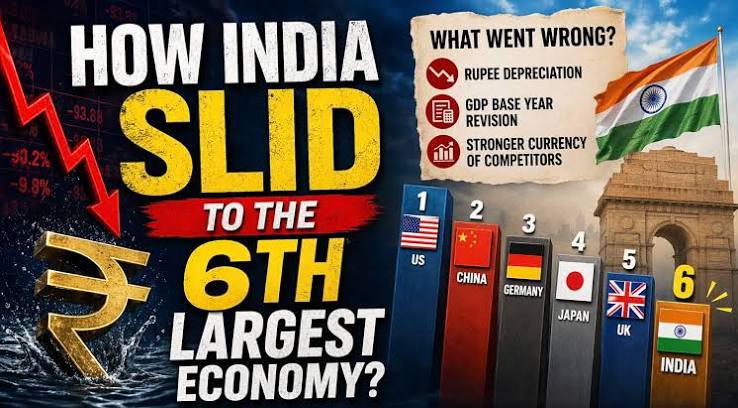
India remains one of the world’s fastest-growing major economies, but its position in the global ranking by nominal GDP has changed. According to the International Monetary Fund’s April 2026 World Economic Outlook, India’s nominal GDP was estimated at around $3.92 trillion in FY2025-26, placing the country as the sixth-largest economy in the world. The latest figure was also presented by the government in Parliament.
The ranking has attracted attention because India had previously been widely described as the world’s fourth-largest economy. The latest IMF estimates put the United Kingdom and Japan ahead of India in nominal GDP terms. However, this change does not mean that India’s economy has suddenly contracted. The ranking is based on GDP measured in current US dollars, meaning exchange-rate movements can have a major impact on the position of countries in the global table.
The rupee’s movement against the US dollar has been one of the factors behind the change. When the domestic currency weakens against the dollar, the value of an economy measured in US dollars can fall even if economic activity inside the country continues to expand. Analysts have also pointed to India’s recent GDP data revision and the change in the GDP base year as factors affecting the comparison.
This distinction is important for understanding the headline. India has not become a smaller economy in domestic terms simply because its global nominal ranking has moved lower. In fact, India’s real economic growth remains strong. The World Bank reported that the Indian economy grew by 7.6% in FY26, up from 7.1% in FY25, supported by domestic demand, manufacturing and services.
Domestic consumption continues to be one of India’s biggest economic strengths. A large population, rising urbanisation, expanding digital payments and increasing formalisation of economic activity are supporting demand across sectors such as retail, financial services, automobiles, housing and consumer goods.
Investment is another important part of the growth story. Government spending on infrastructure, along with private-sector investment in manufacturing, technology, renewable energy and logistics, is helping expand productive capacity. India is also trying to attract more global companies as businesses look to diversify their supply chains beyond traditional manufacturing hubs.
The services sector remains a major contributor to the economy. Information technology, financial services, professional services and business-process operations continue to generate significant economic activity and export earnings. At the same time, policymakers are trying to increase manufacturing’s contribution through initiatives aimed at electronics, semiconductors, automobiles, pharmaceuticals and other industries.
The size of India’s economy is also important from an international perspective. A GDP of nearly $4 trillion gives the country considerable weight in global trade, investment and financial markets. India’s large domestic market makes it attractive to multinational companies looking for long-term growth opportunities.
However, GDP size alone does not tell the complete story. India’s per-capita income remains much lower than that of developed economies because the country’s population is considerably larger. Therefore, moving up the global GDP ranking does not automatically mean that living standards have increased at the same pace.
Another important factor is the difference between nominal GDP and purchasing-power-parity (PPP) GDP. Nominal GDP converts economic output using market exchange rates, while PPP attempts to account for differences in the cost of goods and services between countries. India ranks much higher when measured by PPP.
For investors, the latest ranking is therefore better understood as a measurement issue combined with currency movements rather than a sign of a major deterioration in India’s economic fundamentals.
The government will also be watching the outlook for FY27. The World Bank expects India’s growth to moderate to around 6.6% in FY27, partly because of external risks and the impact of geopolitical developments.
India also faces challenges including energy prices, global trade tensions, employment generation, infrastructure requirements and the need to increase productivity. Sustaining high growth over a long period will require continued investment in education, technology, manufacturing and infrastructure.
Despite the change in ranking, the broader picture remains positive. India continues to be among the fastest-growing major economies, with strong domestic demand and a large investment pipeline.
The latest GDP ranking therefore should not be viewed simply as good or bad news. India’s sixth-place position mainly reflects how its economy compares with other countries when measured in current US dollars. The more important question is whether India can maintain strong real growth and translate that expansion into higher incomes, greater productivity and better living standards.
With a nominal GDP of around $3.92 trillion, India remains a major force in the global economy. Its future ranking will depend not only on domestic growth but also on exchange rates, growth in other major economies and future revisions to national economic data.