
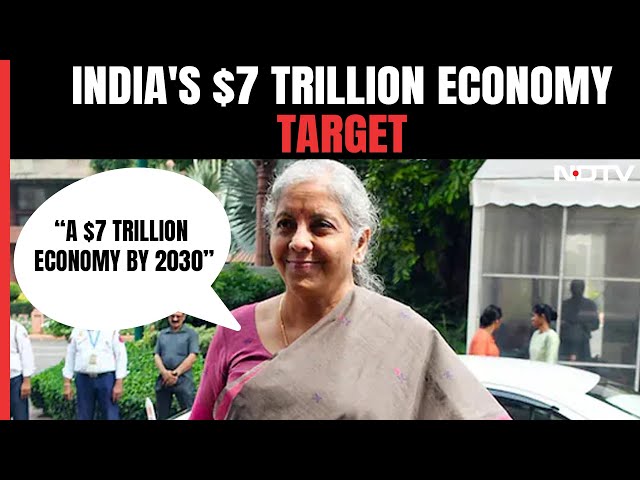
India is setting its sights on becoming a $7 trillion economy over the coming years, driven by strong GDP growth, rising domestic consumption, infrastructure expansion, and continued reforms aimed at improving productivity and global competitiveness.
The target reflects India’s long-term ambition to significantly scale its economic size from current levels, positioning itself among the top global economies. Policymakers believe that sustained growth of around 6.5%–7% annually, combined with structural reforms, can make this goal achievable within the medium-to-long term horizon.
A major driver of this ambition is strong domestic demand. Rising incomes, rapid urbanization, and a growing middle class are fueling consumption across sectors such as housing, automobiles, retail, healthcare, and digital services. This internal demand base provides stability even during periods of global uncertainty.
Investment-led growth is another key pillar. Public capital expenditure on infrastructure—including highways, railways, ports, airports, and energy systems—continues to expand. This has a multiplier effect on private investment, encouraging industries such as construction, steel, cement, and machinery to scale up production.
Manufacturing is expected to play a central role in achieving the $7 trillion target. Initiatives aimed at boosting domestic production, improving supply chain integration, and attracting foreign direct investment are helping India strengthen its position as a global manufacturing hub. Sectors like electronics, automobiles, defense equipment, chemicals, and pharmaceuticals are key growth engines.
The services sector remains a dominant contributor to economic expansion. Information technology, financial services, telecommunications, and professional services continue to benefit from global demand and rapid digital transformation, including adoption of artificial intelligence, cloud computing, and automation.
Exports are also expected to contribute significantly. India is targeting stronger participation in global trade, with ambitions such as reaching $1 trillion in exports. Improving trade agreements, logistics infrastructure, and competitiveness in manufacturing are central to this strategy.
Foreign investment inflows remain another important growth driver. Global companies are increasingly viewing India as a preferred destination due to its large consumer base, policy reforms, and role in diversified supply chains. Sectors such as renewable energy, semiconductors, and digital technologies are attracting significant interest.
However, achieving a $7 trillion economy will require overcoming key challenges. These include infrastructure gaps in certain regions, regulatory complexity, skill development needs, and global economic uncertainties. Maintaining fiscal discipline while supporting growth-oriented spending will also be crucial.
Economists note that India’s demographic advantage—particularly its young workforce—provides a long-term structural boost. If combined with higher productivity, stronger manufacturing growth, and deeper integration into global value chains, the economy could expand rapidly in the coming years.
Overall, the $7 trillion goal reflects the long-term economic vision of India to become a major global economic powerhouse, supported by sustained reforms, investment, and strong domestic demand.