
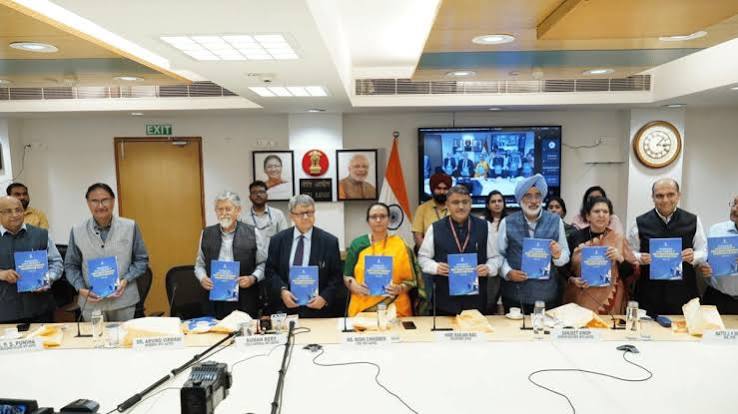
India’s telecom and network equipment industry could become a major part of the country’s manufacturing and export story, with NITI Aayog projecting the sector could reach around $50 billion by FY2032. The domestic market is currently estimated at about $25 billion, giving India significant room to expand production and build a stronger position in global telecom supply chains.
The opportunity comes as demand for telecom infrastructure continues to rise around the world. The global telecom equipment market is expected to grow from roughly $498 billion in FY2023 to $714 billion by FY2030. India’s own demand is being supported by the rollout of 5G, rising internet and data usage, broadband expansion, fibre networks, smart cities, industrial automation and the growing use of connected devices.
However, NITI Aayog has pointed out that India still has a major gap between its domestic demand and its export performance. Telecom and network equipment exports have remained relatively small at around $0.6 billion to $1 billion annually, while imports have been much higher at around $4 billion to $5 billion every year. This means India is still dependent on overseas suppliers for a large part of its telecom equipment requirements.
One of the biggest challenges is the limited availability of locally manufactured components. According to the NITI Aayog report, more than 80% of critical imported components come from China. Localisation is also low in some important product categories. For example, domestic localisation has been estimated at only around 4% for 4G/LTE RAN base stations and 5% for 5G RAN base stations.
The government’s Production Linked Incentive, or PLI, scheme has already helped increase manufacturing in areas such as optical fibre cables, routers, switches and customer-premises equipment. Indian companies including Tejas Networks, HFCL and VVDN Technologies have emerged as important players, while international companies such as Nokia, Ericsson, Samsung and Sanmina have also expanded manufacturing operations in India.

But simply increasing assembly capacity will not be enough if India wants to become a serious global supplier. The NITI Aayog study recommends deeper localisation, greater domestic value addition, technology partnerships and stronger manufacturing capabilities for critical components. It also highlights the need for better testing and certification facilities and industrial clusters that can help companies operate more efficiently.
The report also suggests that government incentives should increasingly be linked to actual domestic value addition rather than just production volumes. Joint ventures and technology-transfer arrangements could help Indian manufacturers gain access to advanced technologies and move beyond assembly-based manufacturing.
For India, the potential benefits are significant. A stronger telecom equipment industry could reduce dependence on imports, create manufacturing jobs, improve supply-chain security and increase high-value exports. It could also strengthen India’s position as countries around the world diversify their telecom supply chains.
The opportunity is particularly important because telecom networks are becoming critical infrastructure for economies. The expansion of 5G, future 6G technologies, cloud computing, artificial intelligence, Internet of Things devices and high-speed broadband will continue to create demand for network equipment.
NITI Aayog’s assessment therefore presents both an opportunity and a warning. India has a large domestic market and growing manufacturing capabilities, but it must build a deeper component ecosystem if it wants to capture a meaningful share of the global market. If the country can address its import dependence and improve local technology and value addition, the telecom equipment sector could become one of the key pillars of India’s ambition to become a global manufacturing hub.