

The India–Australia Uranium Export Agreement marks a significant milestone in the strategic and energy partnership between the two countries. The agreement enables Australia, one of the world’s largest uranium producers, to export uranium exclusively for India’s civilian nuclear energy program. The deal reflects growing trust between the two democracies and supports India’s long-term goal of achieving energy security while reducing carbon emissions.
Australia possesses nearly one-third of the world’s known uranium reserves, making it a major supplier of nuclear fuel. For many years, Australia had declined uranium exports to India because India is not a signatory to the Nuclear Non-Proliferation Treaty (NPT). However, after India’s strong non-proliferation record and the signing of the India–Australia Civil Nuclear Cooperation Agreement, Australia decided to permit uranium exports under strict safeguards.
The agreement is designed to ensure that Australian uranium is used only for peaceful purposes. All uranium supplied to India is monitored under the safeguards of the International Atomic Energy Agency (IAEA), ensuring transparency and compliance with international nuclear safety standards. This framework reassures Australia that its uranium exports will not be diverted for military use.

For India, the agreement is a major boost to its nuclear energy ambitions. As electricity demand continues to rise due to rapid urbanization, industrial growth, and population expansion, India is seeking reliable and cleaner sources of energy. Nuclear power is considered an essential component of India’s strategy to reduce dependence on fossil fuels and achieve its climate commitments. Access to Australian uranium helps ensure a stable supply of fuel for India’s growing fleet of nuclear reactors.
The agreement also strengthens the broader strategic relationship between India and Australia. In recent years, both countries have expanded cooperation in defence, maritime security, trade, critical minerals, education, and technology. Their partnership has gained additional importance in the Indo-Pacific region, where both nations support a free, open, and rules-based international order. The uranium agreement has become an important pillar of this evolving strategic partnership.
Economically, the agreement benefits Australia by opening a large and growing market for its uranium industry. India is among the fastest-growing energy consumers in the world, and its plans to expand nuclear power generation create long-term business opportunities for Australian mining companies. Increased uranium exports also contribute to Australia’s resource export revenues while supporting employment in its mining sector.
From India’s perspective, diversifying uranium imports enhances energy security. India already imports uranium from several countries, including Kazakhstan, Canada, Russia, and Uzbekistan. Australia adds another dependable source, reducing the risks associated with relying on limited suppliers. A diversified fuel supply is particularly important as India plans to significantly increase the share of nuclear power in its overall energy mix over the coming decades.
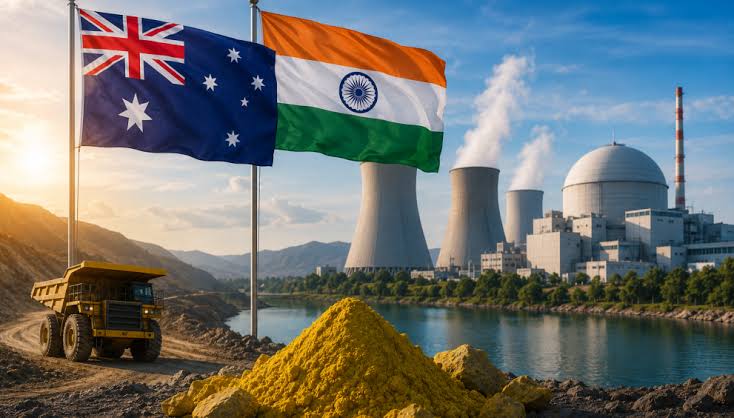
The agreement also supports global efforts to combat climate change. Nuclear energy generates electricity with very low greenhouse gas emissions during operation. By ensuring access to reliable nuclear fuel, the agreement contributes to India’s transition toward cleaner energy while complementing renewable energy sources such as solar and wind. This balanced energy strategy is expected to play an important role in meeting India’s future electricity demand without significantly increasing carbon emissions.
Despite its benefits, the agreement has also attracted debate. Some critics have expressed concerns over nuclear safety, radioactive waste management, and the long-term environmental impacts of uranium mining. Others have questioned uranium exports to a country outside the NPT framework. However, both governments have emphasized that the agreement includes robust safeguards, international oversight, and strict verification mechanisms to ensure peaceful use.
Overall, the India–Australia Uranium Export Agreement represents far more than a commercial transaction. It symbolizes growing mutual trust, expanding strategic cooperation, and a shared commitment to clean energy development. As India continues to expand its civilian nuclear energy capacity and Australia strengthens its role as a reliable supplier of critical resources, the agreement is expected to remain a cornerstone of bilateral relations and contribute to regional stability, sustainable development, and long-term energy security.