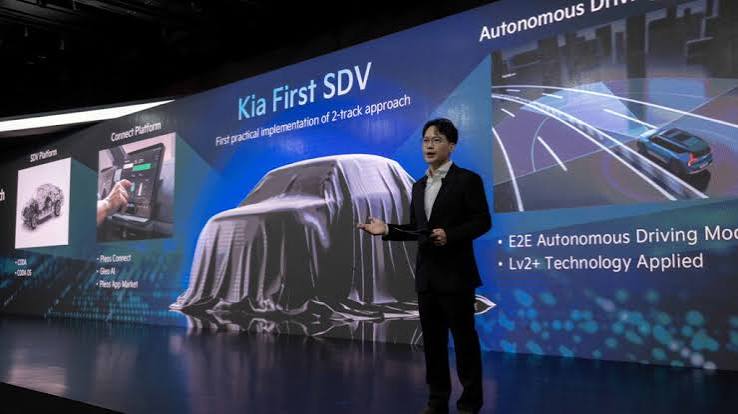
The expansion comes as Kia expects demand for SUVs, electric vehicles and hybrid models to rise significantly over the next few years. The company sees India not only as an important sales market but also as a key manufacturing and export base for its global operations.
Kia currently operates its major manufacturing facility in Anantapur, Andhra Pradesh. The plant has played an important role in the company’s rapid growth in India since local production began in 2019. With the company now targeting much higher sales by the end of the decade, increasing local production capacity will become an important part of its strategy.
By 2030, Kia wants to sell approximately 410,000 vehicles every year in India, compared with around 289,000 units sold during FY2025-26. The target would take the company to a market share of roughly 7.6%, according to the company’s latest India strategy.
A large part of this growth is expected to come from Kia’s popular compact SUV range. The company plans to increase sales of the Seltos and Sonet, with a long-term objective of selling more than 200,000 units of each model annually. These two vehicles are expected to remain important volume drivers as Kia attempts to reach its 2030 target.
However, Kia’s strategy is not limited to petrol and diesel vehicles. The company is preparing to significantly expand its electrified portfolio in India. Its roadmap includes new electric and hybrid models aimed at customers across different price segments.

The company has already introduced the Carens Clavis EV and is preparing additional products, including the Syros EV. Kia has also announced plans for models such as the Sorento Hybrid and Carnival Hybrid for the Indian market. The company is expected to use a combination of locally produced vehicles and imported models as it expands its product range.
The shift towards electric and hybrid vehicles is important because India’s automobile market is gradually changing. Consumers are becoming more interested in fuel efficiency, lower running costs and cleaner technologies, while government policies are also encouraging greater adoption of electric mobility.
Kia’s expansion could also strengthen India’s position within the company’s international supply chain. The company plans to increase local production and expand its completely knocked-down, or CKD, operations. This could allow India to play a bigger role in supplying vehicles and components to other emerging markets.
The company is also looking at increasing supply flexibility. Instead of relying only on one market or a limited number of models, Kia wants to create a broader production and product network that can respond to demand in India as well as overseas markets.
The planned expansion comes at a time when competition in India’s passenger vehicle market is becoming increasingly intense. Maruti Suzuki, Hyundai, Tata Motors, Mahindra, Toyota and several other manufacturers are investing heavily in SUVs, EVs and hybrid technology. New global players are also entering India’s electric vehicle market, making the next few years particularly important for established manufacturers.
Kia’s 4.1-lakh-unit target therefore represents a significant increase in scale. To achieve it, the company will need strong demand across its existing models, successful launches of new products and sufficient manufacturing capacity.
The company also expects its dealer network and customer reach to expand alongside production. A larger sales and service network will be important if Kia wants to increase its presence beyond the major urban markets and attract customers in smaller cities and towns.
For India, the expansion could bring wider benefits as well. Higher local production can support employment, component suppliers, logistics companies and other businesses connected to the automobile industry. Greater localisation can also help manufacturers reduce their dependence on imported components and improve supply-chain efficiency.
Kia’s plans show that the company is taking a long-term view of the Indian market. With a combination of additional production capacity, new SUVs, electric vehicles and hybrid models, Kia is positioning itself for another phase of growth.
The real test will be whether the company can maintain its current momentum while dealing with rising competition and the rapid transition towards electrification. If Kia successfully executes its product and manufacturing plans, its target of 4.1 lakh annual sales by 2030 could significantly strengthen its position in India’s competitive passenger vehicle market.