

Adani Green Energy is continuing its aggressive expansion in India’s renewable-energy sector, strengthening its position as one of the country’s largest clean-power producers. The company has been rapidly adding solar, wind and hybrid generation capacity while also investing in battery storage and pumped-hydro projects.
The latest expansion comes after a major capacity addition during FY2025-26. Adani Green Energy added 5,051 MW, or about 5.1 GW, of renewable capacity during the financial year, taking its total operational portfolio to approximately 19.3 GW. The company said this was its highest annual greenfield capacity addition and one of the largest such expansions globally outside China.
The new capacity included around 3.4 GW of solar power, 683 MW of wind power and 956 MW of solar-wind hybrid capacity. A large part of this expansion has come from the company’s flagship renewable-energy development at Khavda in Gujarat, which has become one of the world’s most closely watched large-scale clean-energy projects.
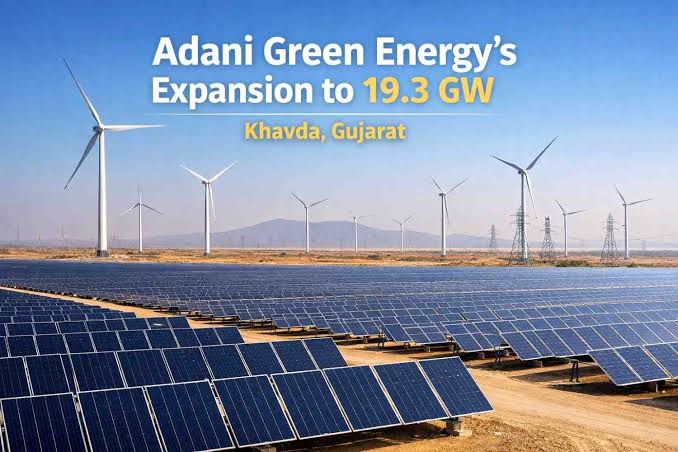
Khavda is central to Adani Green’s long-term strategy because of its enormous renewable-energy potential. The company is developing a combination of solar, wind and hybrid generation facilities in the region, allowing it to use different renewable resources and improve the overall utilisation of the power infrastructure.
Adani Green is also putting increasing emphasis on energy storage. Renewable power generation is naturally variable because solar generation depends on sunlight and wind generation depends on weather conditions. Battery storage can help store electricity when production is high and release it when demand increases.
As of March 31, 2026, the company had 1,376 MWh of operational battery energy-storage capacity. Its annual report also highlights battery storage as a major future growth area, alongside pumped-hydro storage.
The company has set an ambitious long-term target of reaching 50 GW of operational renewable capacity by 2030. With 19.3 GW already operational at the end of FY2026, Adani Green has made significant progress toward that goal.
The expansion comes as India’s electricity demand continues to increase. Rapid industrialisation, urbanisation, data centres, electric vehicles and rising household electricity consumption are all expected to increase the country’s need for additional power generation.
At the same time, India is trying to increase the share of non-fossil sources in its electricity system. This is creating opportunities for renewable-energy companies to develop large solar and wind projects, although transmission infrastructure and energy storage remain important challenges.
Adani Green’s financial performance has also benefited from its growing renewable portfolio. During the first nine months of FY2026, the company’s revenue from power supply increased 25% year-on-year to ₹8,508 crore, while EBITDA from power supply rose 24% to ₹7,921 crore. The company attributed the improvement to capacity additions, strong plant performance and the commissioning of new projects.
The scale of the expansion means that execution will remain a key factor for the company. Large renewable projects require substantial investment in generation equipment, transmission infrastructure, land, storage systems and supporting facilities. Delays in grid connections, equipment availability or project execution can affect the timing of revenue generation.
Financing is another important consideration. Renewable-energy projects require large amounts of upfront capital, while returns are generated over many years through electricity sales and power-purchase arrangements. Maintaining a sustainable funding structure will therefore remain important as Adani Green continues to expand.
The company is also looking beyond conventional solar and wind projects. Battery storage and pumped-hydro systems are becoming increasingly important because they can help address the intermittent nature of renewable power. Adani Green’s annual report identifies storage as a key part of its strategy for building a more flexible and reliable clean-energy portfolio.
For India, the company’s expansion is significant because large renewable projects can add substantial amounts of clean electricity to the national grid while reducing dependence on fossil-fuel-based generation over time.
Adani Green’s progress also reflects the broader transformation taking place in India’s power sector. Renewable capacity is growing rapidly, but the next phase of the energy transition will depend not only on building more solar panels and wind turbines but also on developing stronger transmission networks and large-scale storage.
With 19.3 GW already operational and a target of 50 GW by 2030, Adani Green Energy is preparing for another major phase of expansion. The company’s ability to execute projects efficiently, manage financing and integrate storage with renewable generation will determine how successfully it can maintain its rapid growth.
For investors and the wider energy industry, Adani Green’s expansion is therefore an important indicator of where India’s renewable-power market is heading. The company is moving from simply adding generation capacity toward building a broader clean-energy ecosystem combining solar, wind, hybrid power and storage.