
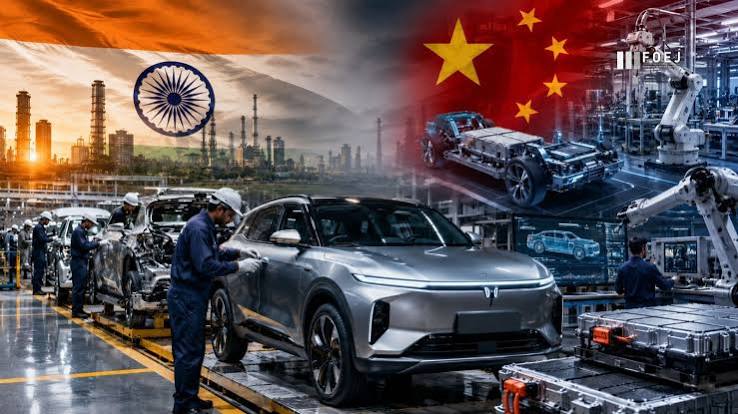
Chinese electric vehicle (EV) technology is gradually making its way into India through indirect channels such as component imports, licensing arrangements, joint ventures, and technology partnerships with global and domestic automakers. While direct Chinese EV investments remain limited due to regulatory and geopolitical constraints, industry experts say China’s influence in India’s EV ecosystem is still growing through the back door of supply chains.
A key driver of this trend is China’s dominance in critical EV components, especially batteries, battery management systems, rare earth materials, and power electronics. Since China controls a large share of global lithium-ion battery production and processing, many Indian EV manufacturers and component suppliers rely on Chinese inputs either directly or through third-country suppliers in Southeast Asia.
Global EV companies operating in India are also playing a role in technology transfer. Several multinational automakers that source platforms, software systems, or battery technologies from Chinese suppliers are introducing those technologies into the Indian market through localized production or assembly operations. This creates an indirect technology flow without formal Chinese ownership in India-based EV companies.

Domestic manufacturers are increasingly adopting Chinese-origin battery chemistries such as lithium iron phosphate (LFP) due to their lower cost and improved safety profile. These technologies are being integrated into electric two-wheelers, three-wheelers, and entry-level passenger EVs, which dominate India’s current EV market. As affordability remains a key factor in adoption, Chinese battery technology has become an important part of cost reduction strategies.
However, this indirect dependence has raised policy and strategic concerns. India has been actively promoting domestic battery manufacturing under initiatives such as production-linked incentives (PLI) for advanced chemistry cells. The goal is to reduce reliance on imports and build a self-sufficient EV supply chain, especially in critical components like cells, cathodes, and semiconductors.
Geopolitical sensitivities also limit direct Chinese participation in India’s EV sector. Investment screening rules and security considerations have made it more difficult for Chinese companies to establish large-scale manufacturing operations in India. As a result, Chinese technology often enters through intermediary countries such as South Korea, Japan, and Southeast Asian manufacturing hubs.
Despite these restrictions, China’s global leadership in EV manufacturing means its influence remains difficult to avoid. Even as India builds its own ecosystem, global supply chains for EVs remain deeply interconnected, with China playing a central role in raw materials, processing, and battery technology.
Industry experts note that this indirect dependence presents both opportunities and risks. On one hand, it allows India to accelerate EV adoption by leveraging proven, cost-effective technologies. On the other hand, it raises concerns about supply chain vulnerability, pricing power, and long-term technological dependence.
To counter this, India is investing heavily in domestic R&D, local battery gigafactories, and partnerships with non-Chinese technology providers. Companies are also exploring alternative chemistries such as sodium-ion and solid-state batteries to diversify future supply options.
Overall, the entry of Chinese EV technology into India—even indirectly—highlights the complexity of global clean energy supply chains. While policy barriers limit direct involvement, technological interdependence continues to shape the evolution of India’s fast-growing electric mobility sector.