

Global oil prices moved higher on Tuesday as uncertainty surrounding US-Iran negotiations raised fresh concerns about the future of energy supplies. Brent crude was trading around $87.80 a barrel, while US West Texas Intermediate crude was near $82.22, with both benchmarks holding close to recent highs.
The main concern for oil markets is the uncertain future of the Strait of Hormuz, a major shipping route for energy supplies from the Middle East. Hopes that the waterway will reopen fully have weakened as the United States and Iran remain divided over the conditions needed to move negotiations forward.
Iran has indicated that the US must meet certain demands before a broader agreement can be reached. Tehran has also said that there are currently no direct talks taking place between the two countries, adding to uncertainty in the market.
The situation has made traders more cautious because any prolonged disruption around the Strait of Hormuz could affect the movement of crude oil and petroleum products. The waterway is one of the world’s most important energy routes, so even the possibility of further disruption can quickly push prices higher.
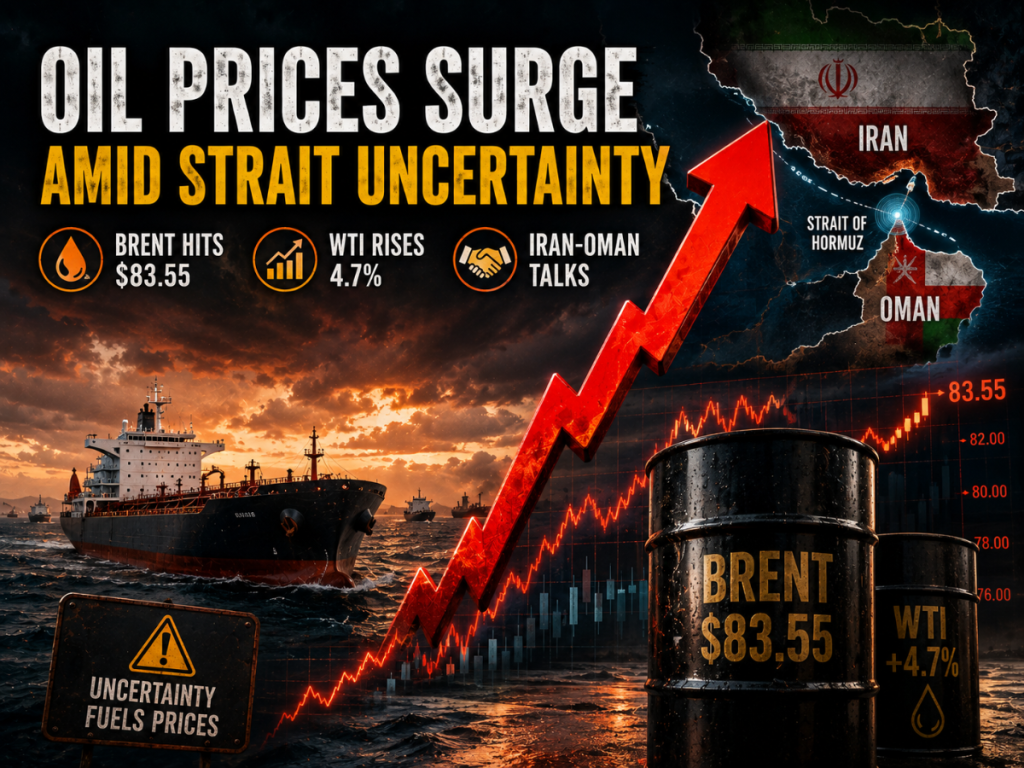
Oil prices had already gained strongly on Monday, rising about 5% as concerns over the negotiations increased. Brent crude climbed to around $87.70 a barrel, while WTI rose to roughly $82.20. The gains came after US President Donald Trump indicated that further escalation with Iran remained possible.
For global economies, higher crude prices can create additional pressure on inflation. Countries that rely heavily on imported oil may face higher fuel and transportation costs if the increase continues. Airlines, shipping companies, manufacturers and other energy-intensive businesses could also see their operating costs rise.
India is particularly sensitive to movements in global crude prices because it imports a large share of its oil requirements. A sustained increase in crude prices can raise the country’s import bill and put pressure on the Indian rupee. It can also increase costs for fuel, transport and several industries.
The uncertainty is not limited to crude oil. The Strait of Hormuz is also important for shipments of liquefied natural gas and other energy products. Any major disruption could therefore have wider consequences for global energy markets.
At the same time, traders are watching diplomatic developments closely. A successful agreement between Washington and Tehran could reduce the geopolitical risk premium in oil prices and encourage more normal energy flows. On the other hand, a breakdown in negotiations or renewed military escalation could keep prices elevated.
Recent market movements show how quickly oil prices can respond to changing expectations. Earlier this month, crude prices dropped sharply when hopes for renewed US-Iran talks increased. The latest rise shows that those expectations can reverse quickly when negotiations face new obstacles.
For now, investors are likely to focus on developments around the US-Iran discussions and the status of shipping through the Strait of Hormuz. Any clear sign of a diplomatic breakthrough could ease oil prices, while further uncertainty over energy supplies could push them higher.
The oil market therefore remains highly sensitive to geopolitical news. With negotiations still uncertain and the future of energy shipments through the region unclear, crude prices are likely to remain volatile in the near term.