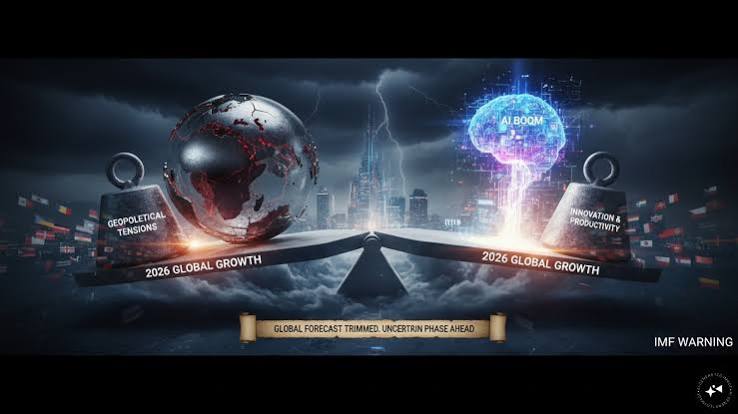
The global economy is showing more resilience than many expected despite the impact of war, energy-market disruptions and continued uncertainty over trade and economic policy. The International Monetary Fund (IMF) has projected that the world economy will grow by 3.0% in 2026, with growth expected to improve to 3.4% in 2027. The IMF’s latest outlook highlights a growing divide between the negative impact of geopolitical shocks and the strong momentum being created by investment in artificial intelligence and technology.
The IMF’s July 2026 World Economic Outlook Update, titled Global Economy in Crosscurrents of War and Technology, says the global economy is being pulled in two different directions. On one side, the war in the Middle East and its impact on energy supplies are creating additional costs for businesses and households. On the other, rapid investment in AI, semiconductors, data centres and other technology-related areas is supporting demand and economic activity in several countries.
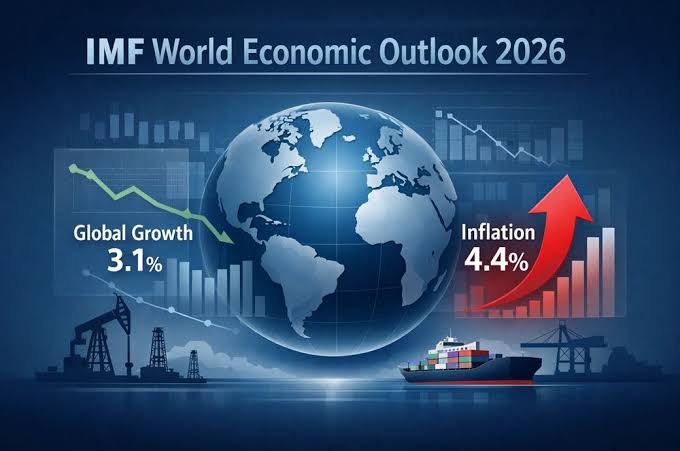
The 3.0% growth forecast is below the average global growth rate of around 3.5% recorded in 2024 and 2025. However, the IMF has kept its overall 2026 and 2027 projections broadly unchanged from its April outlook on a cumulative basis. This suggests that the institution believes the global economy has managed to absorb some of the recent shocks better than initially feared.
One of the biggest positive factors in the outlook is the technology investment cycle. Companies around the world are spending heavily on artificial intelligence, cloud computing, advanced chips, data centres and related infrastructure. This spending is supporting demand for technology equipment and services while also creating new investment opportunities across the global supply chain.
The IMF says economies that are already well connected to global technology supply chains are in a stronger position to benefit from the AI-driven expansion. Countries involved in semiconductor manufacturing, technology services, advanced manufacturing and digital infrastructure could see stronger economic activity as companies increase their AI-related spending.
The impact of the war, however, is uneven. Energy-importing economies are more exposed to higher fuel and transportation costs, while energy exporters outside the conflict zone can benefit from improved terms of trade. Countries with limited participation in the technology sector may receive fewer benefits from the current investment boom and could face a more difficult growth environment.
Inflation remains another concern. The IMF has revised its forecast for global headline inflation to 4.7% in 2026, noting that the progress made in reducing inflation since early 2024 has stalled. Higher energy and commodity prices could keep pressure on consumer prices, particularly in countries that depend heavily on imported fuel.
For central banks, this creates a difficult balancing act. Policymakers need to support economic growth without allowing inflation expectations to rise again. The appropriate response will differ from country to country depending on exposure to energy prices, domestic demand and technology-related investment.
The IMF has also warned that the global outlook remains vulnerable to new shocks. A renewed escalation of the conflict could trigger another rise in energy prices, tighten financial conditions and put additional pressure on economies with limited fiscal space. Developing countries with high food and energy import bills could be particularly vulnerable.
Another major risk is linked directly to the technology boom. While AI investment is currently supporting economic activity, the IMF has cautioned that a sharp reassessment of the profitability of AI-related investments could trigger a correction in financial markets. If investors begin questioning the valuations or future returns of technology companies, investment spending could slow and market volatility could increase.
At the same time, there is an upside scenario. Faster adoption of AI could raise productivity and increase economic growth beyond current expectations. Businesses that successfully integrate AI into production, services and decision-making could become more efficient, potentially supporting higher output without a proportional increase in costs.
The IMF therefore sees technology as both an important source of support and a potential source of financial risk. The current economic environment is unusual because geopolitical instability and technological investment are influencing global growth in opposite directions.
For businesses and investors, the outlook means that technology-related sectors could remain important growth drivers. Semiconductor manufacturers, cloud infrastructure companies, software businesses, data-centre operators and firms providing AI-related services may continue to benefit from high levels of capital spending.
However, investors will need to remain cautious because the global economy is still exposed to geopolitical developments, inflation, interest rates and trade disruptions. A change in any of these factors could quickly affect business confidence and financial markets.
The IMF expects the global economy to experience weaker growth in 2026 followed by stronger expansion in 2027, describing the outlook as broadly consistent with a V-shaped recovery.
Overall, the latest forecast suggests that the world economy is not immune to the effects of war and economic disruption, but the rapid expansion of AI and technology investment is providing an important cushion. Whether that support remains strong will depend on the pace of AI adoption, the sustainability of technology investment and the ability of governments to manage inflation and geopolitical risks.
For now, the global economy appears to be navigating two powerful forces at the same time: the economic damage caused by geopolitical conflict and the growth opportunities created by a new technology cycle.