

India has proposed the creation of a BRICS Startup Innovation Fund and a BRICS Incubator Network, in a move aimed at giving startups across member countries greater access to funding, mentorship, technology and international markets.
The proposal was made during the 10th BRICS Industry Ministers’ Meeting in Jaipur, held under India’s BRICS Chairship 2026. The meeting concluded with ministers adopting a joint declaration focused on strengthening industrial cooperation and promoting innovation-led and sustainable growth across the grouping.
The proposed startup fund could become an important source of support for young companies looking to expand beyond their domestic markets. Startups often face difficulties when they try to enter foreign markets because they need access to capital, business networks, regulatory knowledge and local partners. A BRICS-level platform could help address some of these challenges by connecting entrepreneurs and investors across participating economies.
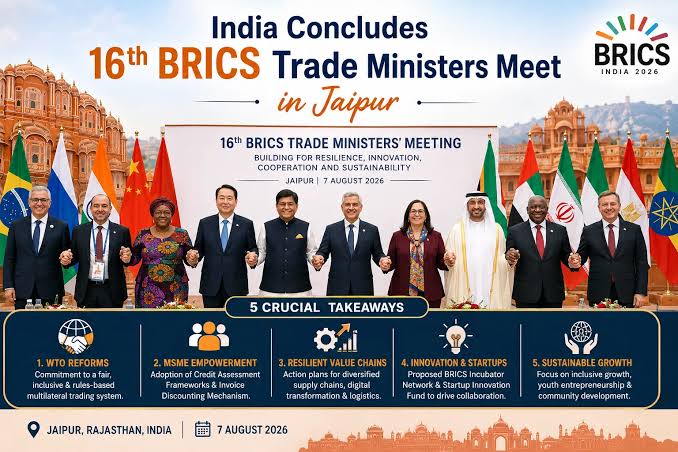
The Incubator Network is expected to provide another layer of support. Business incubators generally help early-stage companies develop their ideas, improve business models, find mentors and connect with investors. By linking incubators across BRICS countries, startups could gain access to expertise and networks outside their home markets.
The initiative builds on India’s earlier efforts to strengthen startup cooperation within BRICS. The BRICS Startup Forum, announced during India’s previous BRICS presidency in 2021, was designed to promote cross-border collaboration and entrepreneurial activities among member countries.
India’s latest proposal takes that cooperation a step further by focusing on institutional support for startups. The idea is to create mechanisms through which promising companies can access capital, knowledge and potential business opportunities across the BRICS ecosystem.
The proposal is also connected to India’s broader Partnership on New Industrial Revolution (PartNIR) agenda. The Jaipur meeting’s joint declaration covered cooperation in areas including MSMEs, startups, photovoltaics and logistics. Ministers also adopted an action plan related to the startup ecosystem, highlighting the importance of innovation and entrepreneurship in future industrial growth.
For Indian startups, stronger links with BRICS markets could open opportunities in sectors such as financial technology, artificial intelligence, renewable energy, healthcare, manufacturing, logistics and digital services. Companies that successfully establish partnerships in other BRICS economies could potentially gain access to much larger customer and investment markets.
The initiative could also benefit investors. A structured BRICS startup ecosystem may make it easier for venture capital firms, corporate investors and other funding institutions to identify companies with international growth potential. Cross-border investment could become particularly useful for startups that have already established their business models domestically and are looking for capital to scale.
However, creating a successful international startup fund will require more than simply announcing the initiative. Differences in regulations, taxation, investment rules, intellectual-property protection and market conditions could make cross-border investments complicated. The participating countries would need to establish clear operating rules and mechanisms for selecting and supporting startups.
India’s proposal therefore represents the beginning of a longer process rather than an immediately operational fund. Details such as the size of the fund, funding sources, eligibility criteria and governance structure will be important in determining how effective the initiative becomes.
The proposal also comes at a time when countries are increasingly competing to attract technology companies and build domestic innovation ecosystems. Startups are becoming an important source of employment, technology development and new business models, making international cooperation increasingly valuable.
For BRICS countries, greater cooperation could help entrepreneurs move beyond their individual domestic markets and build companies capable of competing globally. It could also encourage knowledge sharing between startup ecosystems that have developed different strengths.
India’s role in putting forward the proposal is significant because the country has one of the world’s largest startup ecosystems. Through its 2026 BRICS chairship, India is seeking to place innovation, entrepreneurship and industrial cooperation higher on the group’s agenda.
If the proposed fund and incubator network are eventually implemented, startups could gain access to a broader pool of capital, mentors and international partnerships. For investors and governments, the initiative could provide another way to encourage innovation and strengthen economic ties among BRICS economies.
The immediate focus will now be on developing the proposal into a practical framework. The success of the initiative will ultimately depend on whether BRICS members can agree on funding, governance and cross-border investment mechanisms.
For India’s startup ecosystem, however, the proposal sends a clear message: the country’s ambitions are moving beyond building startups for the domestic market and toward creating stronger international connections for Indian entrepreneurs.