
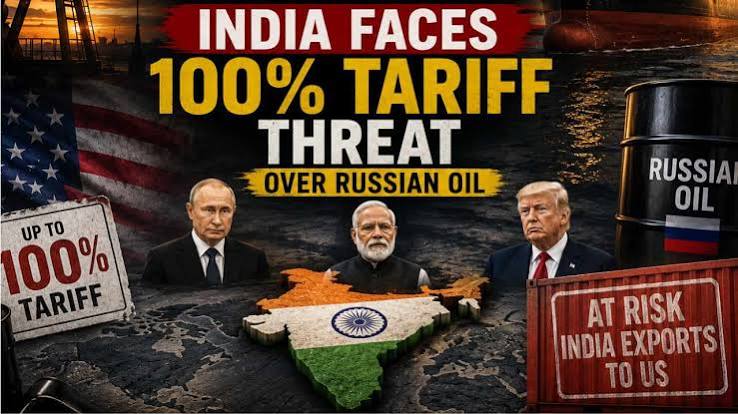
India is facing a fresh trade and economic challenge from the United States after the U.S. Senate passed a major Russia sanctions bill that gives the American president the authority to impose tariffs of up to 100% on countries that continue to purchase significant amounts of Russian oil and gas.
The development has attracted particular attention in New Delhi because India remains one of the world’s largest buyers of Russian crude. However, it is important to note that the 100% tariff has not been imposed on India at this stage. The legislation still has to move through the U.S. House of Representatives and become law before such powers could potentially be used. The Senate passed the bill by an overwhelming 86-11 vote.
The proposed measures are part of a wider U.S. effort to put economic pressure on Russia and reduce the revenue it earns from energy exports. The legislation could allow the U.S. administration to target major buyers of Russian energy, with India and China among the countries that could potentially face higher tariffs.
For India, the issue is particularly sensitive because Russian crude has become an important part of the country’s energy supply. Indian refiners increased purchases of Russian oil after Western countries imposed sanctions and restrictions on Russian energy following the war in Ukraine. Discounted Russian crude has helped Indian refiners secure supplies at competitive prices.
India imports more than 88% of its crude-oil requirements, making international energy prices extremely important for the domestic economy. Any major disruption to crude supplies could affect fuel prices, transportation costs, inflation and the country’s import bill.
The timing of the U.S. proposal is also significant because global oil markets are already facing uncertainty. The Strait of Hormuz has experienced disruptions, while crude prices have remained elevated. Analysts have warned that forcing large buyers to suddenly reduce Russian oil purchases could create additional pressure on the global oil market if alternative supplies are not available in sufficient quantities.
Higher oil prices would create a difficult situation for India. Expensive crude can increase the cost of transporting goods and operating businesses. It can also put pressure on inflation and the Indian rupee because India would need to spend more foreign currency on energy imports.
The proposed U.S. tariff could also affect Indian exporters in another way. If Washington uses the tariff mechanism against India, Indian products entering the U.S. market could become significantly more expensive. American importers may have to pay the additional duty, but higher import costs can ultimately affect demand, product pricing and the competitiveness of Indian exporters.
Sectors that depend heavily on the U.S. market could therefore face greater uncertainty. Indian exporters in areas such as textiles, engineering goods, jewellery, chemicals and other manufactured products would need to assess whether higher duties could reduce their competitiveness against suppliers from other countries.
India has been working to strengthen its trade relationship with the United States, making the latest tariff threat particularly sensitive. The two countries have been negotiating trade arrangements, and New Delhi is expected to continue pushing for exemptions or a waiver if the sanctions legislation becomes law.
The Indian government has so far maintained that its energy purchases are guided by national interest and energy-security requirements. Officials are also closely watching developments in Washington rather than treating the Senate vote as an immediate tariff order.
India also has options to reduce its dependence on any single source of crude. The country already purchases oil from suppliers in the Middle East, Africa and other regions. Diversifying supply sources could help reduce the impact if Russian crude becomes more difficult or expensive to purchase.
However, replacing Russian oil completely would not necessarily be straightforward. Russian supplies have become an important part of India’s refining system, and replacing large volumes quickly could increase costs. Analysts have therefore warned that any sudden reduction in Russian crude purchases could have consequences for global oil prices as well as India’s energy bill.
At the same time, India could use the situation to accelerate export diversification. If access to the U.S. market becomes more difficult, Indian companies may look for opportunities in Europe, the Middle East, Africa, Latin America and other emerging markets.
For the Indian economy, the biggest concern is not the Senate vote itself but what happens next. If the bill becomes law and the administration actually uses the proposed tariff powers, India could face pressure on both sides — higher energy costs and greater uncertainty for exporters.
For now, the situation remains a potential risk rather than an immediate 100% tariff on India. The bill still faces another legislative hurdle in the House, and there could also be negotiations, exemptions or presidential waivers.
India’s immediate priority is therefore likely to be diplomatic engagement, energy diversification and protection of its export interests. The coming weeks could be important for India-U.S. trade relations, particularly as both countries balance economic interests with their broader geopolitical priorities.