
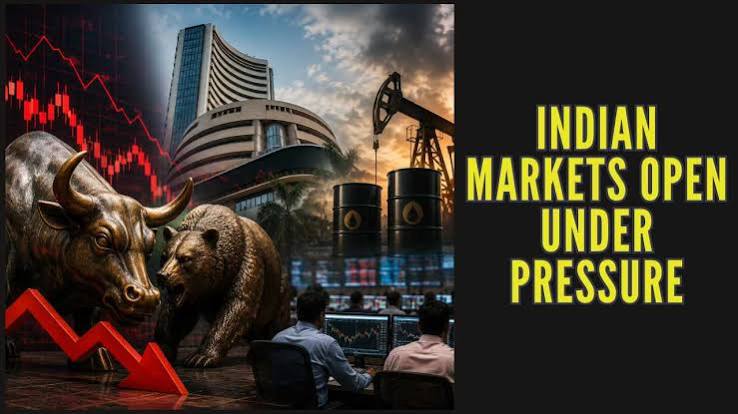
Indian stock markets opened under pressure on Tuesday, with the Sensex falling more than 300 points in early trading. The Nifty 50 also moved lower, slipping below the 24,550 level as investors turned cautious amid rising crude oil prices and continuing geopolitical concerns.
The weak start came after a largely flat session on Monday. Investors are now keeping a close watch on global developments, particularly movements in crude oil prices and tensions in the Middle East. Higher oil prices are a concern for India because the country imports a large share of its crude requirement. A sustained rise in oil prices can increase the country’s import bill and put pressure on inflation as well as the rupee.
The decline in the benchmark indices reflects a cautious mood among investors. When uncertainty increases in global markets, investors often reduce exposure to riskier assets, including equities. This can lead to selling pressure in major Indian indices.
The Sensex and Nifty have also been responding to mixed global signals. While expectations of supportive monetary policy and steady domestic economic growth have provided some support to Indian equities, geopolitical risks and fluctuations in foreign investor flows continue to create volatility.
Oil-sensitive sectors are particularly important to watch during such a session. Higher crude prices can increase costs for companies across several industries, while sectors dependent on transportation and energy may face additional pressure. At the same time, companies with strong domestic demand and limited exposure to imported inputs could remain relatively better placed.
Banking, IT, automobile and energy stocks can also influence the direction of the broader market because of their significant weight in the benchmark indices. Investors are likely to track individual company movements closely rather than reacting only to the headline index numbers.
The market’s opening also comes after the Sensex closed almost unchanged on Monday, gaining just 0.06%. Investors had been balancing positive signals from global markets against concerns surrounding crude oil and geopolitical developments.
For retail investors, a fall of 300 points in the Sensex does not necessarily mean that the market is entering a major correction. The index can move sharply during the day as global cues, institutional flows and commodity prices change. What matters is whether the weakness continues through the session and whether broader market participation also turns negative.
Market participants will therefore watch the Nifty’s movement around key levels, changes in crude oil prices, foreign institutional activity and developments in global markets. A stabilisation in oil prices or improvement in global sentiment could help Indian equities recover, while further escalation in geopolitical tensions could keep investors cautious.
For now, Tuesday’s opening shows that Indian markets remain sensitive to global risks. The combination of higher oil prices, geopolitical uncertainty and cautious investor sentiment has put pressure on the benchmark indices at the start of trading.