
The Reserve Bank of India (RBI) has decided to keep the key repo rate unchanged at 5.25% in its latest bi-monthly monetary policy meeting, signaling a cautious but stable outlook for the Indian economy. The decision reflects the central bank’s assessment that inflation is broadly under control, while growth remains steady despite global uncertainties.
Announcing the policy, the Monetary Policy Committee (MPC) unanimously voted to maintain a neutral stance. Along with the repo rate, the standing deposit facility rate remains at 5.00%, while the marginal standing facility rate and the bank rate continue at 5.50%. The decision aligns with expectations that the RBI would prioritize stability after a period of aggressive tightening aimed at controlling inflation.
RBI Governor Sanjay Malhotra stated that the current economic environment allows the central bank to maintain policy continuity while closely monitoring evolving risks. Inflation trends have moderated compared to previous years, particularly due to easing global commodity prices and improved supply conditions. However, the RBI emphasized that it is not yet ready to signal any immediate rate cuts.
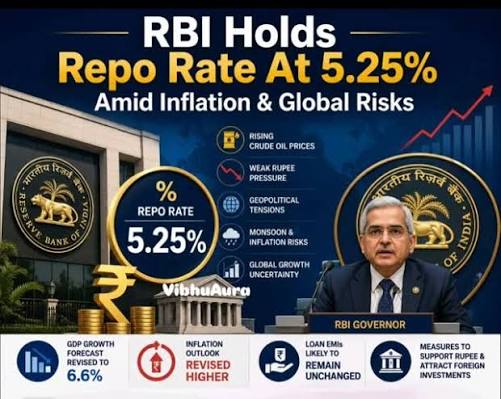
Recent economic indicators show that India’s growth remains relatively strong, supported by resilient domestic demand, robust banking sector performance, and steady credit expansion. However, the RBI has revised its medium-term growth outlook slightly downward to 6.6% for FY2026–27, reflecting external headwinds such as global geopolitical tensions and fluctuations in energy prices.
One of the key supporting factors for the current policy stance is the easing of crude oil prices, which has reduced pressure on India’s import bill and helped stabilize inflation expectations. Lower energy costs are expected to provide some relief to both consumers and businesses, although the RBI has cautioned that oil markets remain volatile due to geopolitical risks.
The financial stability of the banking sector has also played an important role in shaping the RBI’s outlook. According to recent assessments, Indian banks are expected to maintain strong balance sheets with gross non-performing assets (NPAs) remaining below 2% in the coming years. Credit growth has remained healthy, and profitability levels in the banking sector continue to support overall economic stability.
However, the RBI has flagged certain risks that require close monitoring. Household debt levels have risen, driven largely by consumption loans and increased reliance on secured lending such as gold-backed credit. The central bank has warned that any sudden shocks, such as a drop in asset prices, could impact repayment capacity in certain segments.
The Indian rupee has also remained under pressure, depreciating against the U.S. dollar amid global capital outflows. While RBI measures aimed at attracting foreign inflows have provided some support, economists expect the currency to remain relatively weak in the near term due to global financial tightening and external uncertainties.