

Cybersecurity in 2026 has entered a new phase of complexity as attackers increasingly leverage artificial intelligence, supply chain weaknesses, and automation to scale their operations. Governments, enterprises, and individuals are facing a rapidly evolving threat landscape where traditional defense mechanisms are struggling to keep up.
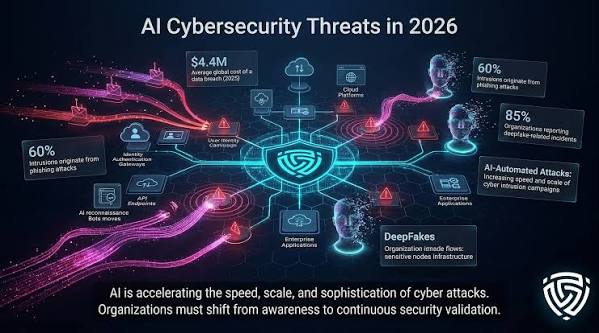
One of the most significant developments this year is the rise of AI-driven cyberattacks. Threat actors are now using generative AI tools to create highly convincing phishing emails, deepfake audio messages, and adaptive malware that can change its behavior depending on the target environment. These attacks are more personalized and harder to detect than conventional scams, leading to a sharp increase in successful breaches targeting both individuals and corporate employees.
Another major concern is the continued exploitation of zero-day vulnerabilities. Security researchers have reported a growing black market for unknown software flaws, where exploits are being sold for millions of dollars. High-profile incidents involving enterprise software platforms have highlighted how a single unpatched vulnerability can compromise entire networks, including cloud infrastructures and critical business systems.
Ransomware groups remain highly active in 2026, but their tactics have evolved. Instead of simply encrypting data, attackers now focus on “double extortion” and even “triple extortion” strategies. In addition to locking systems, they threaten to leak sensitive data and directly contact customers or partners of the victim organization. This has increased pressure on companies to pay ransoms quickly, although law enforcement agencies worldwide continue to advise against it.
Supply chain attacks have also become more frequent and sophisticated. Cybercriminals are increasingly targeting third-party vendors and software providers as a way to infiltrate larger organizations. A compromised update or malicious dependency can silently spread to thousands of downstream systems before detection. This has prompted governments and regulatory bodies to enforce stricter cybersecurity compliance requirements for software vendors and critical infrastructure providers.
On the defensive side, cybersecurity firms are responding with AI-powered detection systems that can analyze network behavior in real time. These systems are designed to identify anomalies, flag suspicious activity, and isolate compromised endpoints before attackers can spread laterally. However, experts warn that this creates an “AI vs AI” battlefield, where both attackers and defenders are continuously improving their algorithms.
Governments across the globe are also strengthening cyber defense strategies. International cooperation has increased, with intelligence-sharing agreements aimed at tracking ransomware groups and dismantling cybercrime networks. At the same time, new cybersecurity regulations are being introduced, requiring organizations to report breaches faster and implement stronger encryption standards.
Despite these efforts, the shortage of skilled cybersecurity professionals remains a major challenge. Organizations are struggling to fill roles in threat intelligence, incident response, and security architecture. This talent gap is expected to persist, making automation and managed security services even more critical in the coming years.
As digital transformation continues across industries, cybersecurity is no longer just an IT concern—it has become a core business and national security priority. The events of 2026 underline a clear reality: cyber threats are evolving faster than ever, and resilience will depend on continuous innovation, global collaboration, and proactive defense strategies.