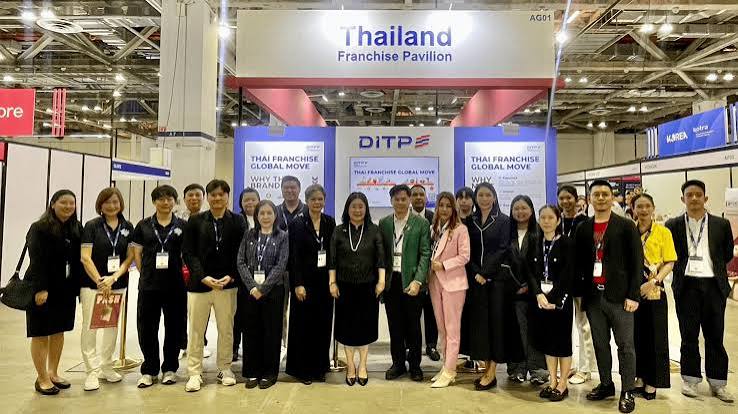
Thailand is using one of Asia’s major franchising events in Singapore to give its homegrown brands a bigger push into international markets. At Franchising & Licensing Asia (FLAsia) 2026, which runs from August 13 to 15 at the Sands Expo and Convention Centre in Singapore, the Thailand Trade Center is showcasing 10 Thai franchise brands as part of the country’s effort to expand its franchise industry beyond its domestic market.
The initiative is being carried out under Thailand’s “Thai Franchise Global Move” project, led by the Department of International Trade Promotion (DITP). The goal is straightforward: help Thai entrepreneurs find investors, franchise partners and business opportunities in Singapore and other overseas markets. For smaller and growing brands, an international exhibition such as FLAsia provides a chance to meet potential partners without having to enter every market on their own.
The Thai pavilion features 10 brands from different parts of the franchise industry. They include MOOMGAPAO, PASH JUICE, JIANCHA, Math Talent by Dr. Ying, Tuk Tuk, Molly Ally, Toro Fries, Sho Ramen, Guichai Hiso and Colla Tea. The group covers food, beverages and education, giving international investors a look at the variety of business models emerging from Thailand.
For Thailand, franchising is more than simply opening restaurants in other countries. A successful franchise model allows a brand owner to expand through local partners who understand the target market. The local franchisee can provide knowledge of consumer preferences, property markets, regulations and hiring conditions, while the original brand provides its products, operating system, training and marketing approach.
That model can be particularly useful for Thai food and beverage businesses. Thai cuisine already has a strong international reputation, and brands offering familiar Thai flavours can potentially find customers across Southeast Asia and other regions. However, international expansion still requires careful adaptation. Pricing, menu preferences, local regulations and customer habits can differ significantly from one country to another.

The Singapore event gives the participating companies an opportunity to address those issues directly with potential partners. The Thailand Franchise Pavilion is operating under the theme “Let’s meet. Connect. Invest. Expand.”, reflecting its focus on business networking and investment rather than simply displaying products.
FLAsia itself has become an important meeting point for franchise and licensing businesses across Asia. The 2026 edition is the event’s 21st edition and is expected to bring together more than 250 brands, with visitors from more than 50 countries. The exhibition is designed to connect franchisors, investors, entrepreneurs and brand owners looking for opportunities to expand across regional and international markets.
Singapore is particularly important in this strategy because of its position as a regional business and investment hub. Its strong international connectivity and business-friendly environment make it a useful starting point for brands looking to build relationships across Southeast Asia. For Thai companies, Singapore can therefore serve not only as a potential market but also as a place to meet investors and partners from other countries.
The participation also highlights the growing importance of franchising as a way for small and medium-sized businesses to expand internationally. Instead of investing all of their own capital in stores and operations overseas, companies can use franchising to share investment and operational responsibilities with local partners.
At the same time, international franchise expansion comes with challenges. Brands need to protect their identity and product quality while allowing franchise partners enough flexibility to operate effectively in different markets. They also need reliable supply chains, clear franchise agreements, training systems and strong quality-control processes.
For investors, the Thai pavilion provides an opportunity to evaluate these businesses directly. Potential franchise partners can learn about each company’s concept, investment requirements and expansion plans, while the Thai brands can assess whether a prospective partner has the local experience and resources needed to build the business successfully.
The initiative also supports Thailand’s wider goal of strengthening its position as an exporter of business concepts and consumer brands. Thai companies have already established international presence in areas such as food, hospitality, wellness and retail. Encouraging more businesses to adopt scalable franchise models could help increase Thailand’s overseas commercial footprint.
The timing is also significant as consumer markets across Asia continue to develop. Rising middle-class populations, urbanisation and increasing interest in international food and lifestyle brands are creating opportunities for companies that can offer products suited to local consumers.
For the 10 participating Thai brands, FLAsia 2026 is therefore more than a trade exhibition. It is an opportunity to test international demand, meet potential franchisees and build relationships that could lead to new outlets outside Thailand.
Thailand’s participation ultimately shows how franchising is becoming an increasingly important route for businesses seeking global growth. By combining established Thai brands with international investors and local business partners, the country hopes to turn successful domestic concepts into internationally recognised businesses. If these brands can secure the right partners at FLAsia, the event could become an important stepping stone in their expansion across Asia and beyond.