
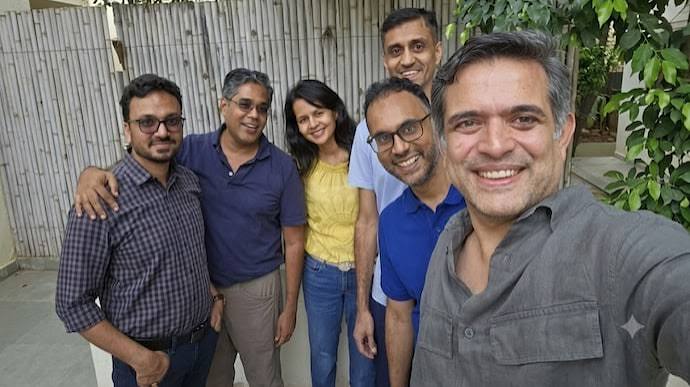
Three Indian semiconductor engineers have taken an unusual route into one of the world’s most advanced areas of technology. Sujoy Chakravarty, Ravi Mehta and Biman Chattopadhyay spent nearly six months studying quantum computing after already building and selling a successful semiconductor company. Their self-study eventually led to the creation of Quanfluence, a Bengaluru-based startup working to develop commercially useful quantum-computing technology in India.
The founders were not newcomers to high-end technology. The three engineers had worked together for more than a decade at Texas Instruments, where they developed experience in semiconductor engineering and chip design. In 2012, they co-founded Silicon and Beyond, a company focused on high-speed semiconductor intellectual property. The company was later acquired by electronic-design-automation giant Synopsys in 2018.
After the acquisition, the three could have continued their careers in the semiconductor industry. Instead, they decided to explore a much harder problem: whether India could build commercially viable quantum-computing systems.
What followed was nearly six months of intensive learning. The founders studied several approaches to quantum computing, including superconducting systems, trapped-ion technology and photonics. Their research eventually convinced them that photonic technology offered an interesting path because it can operate at room temperature, unlike superconducting quantum computers that require extremely low temperatures.
That research became the foundation for Quanfluence. The startup was built with support from academic experts, including Professor Anil Prabhakar of IIT Madras, whose work on Optical Ising Machines forms an important part of the company’s technology. Professor Sandeep Goyal of IISER Mohali and former Arista Networks product leader Aditi Vaidya have also been involved with the venture.
Quanfluence is taking a different approach from many companies developing conventional gate-based quantum computers. Its system uses photonics and focuses on solving optimisation problems. The company’s Optical Ising Machine currently handles 128 interconnected variables, with plans to work on significantly larger problems in future versions.
The startup has also moved beyond research. Its technology is being made available through the cloud, allowing enterprise customers to access its computing capabilities without having to purchase and operate quantum hardware themselves. This could be an important part of the company’s commercial strategy because quantum computing remains expensive and technically difficult to deploy.
Quantum computing is attracting attention worldwide because of its potential applications in areas where conventional computers can struggle with extremely complex calculations. Possible use cases include logistics optimisation, drug discovery, financial modelling, artificial intelligence, materials research and cybersecurity.
The technology works differently from traditional computing. Classical computers process information using bits represented as zeros and ones. Quantum systems use quantum states to perform certain types of calculations in fundamentally different ways. However, building a practical quantum computer remains a major scientific and engineering challenge.
This is why the story of the three founders is particularly interesting. They did not begin their second venture as established quantum-computing specialists. Instead, they used their existing semiconductor knowledge and spent months learning a new field before deciding which technology they wanted to pursue.
Their journey also reflects the changing nature of India’s deep-tech startup ecosystem. For years, India’s technology industry was strongly associated with IT services and software. More recently, Indian companies and researchers have started moving deeper into areas such as semiconductors, artificial intelligence, space technology and quantum computing.
India’s government has also been trying to build a stronger domestic quantum ecosystem through the National Quantum Mission, while universities, technology companies and startups are investing in research and commercial applications.
Quanfluence’s approach is significant because room-temperature photonic systems could potentially avoid some of the infrastructure challenges associated with superconducting quantum machines. However, the technology is still developing, and claims about future performance should be viewed carefully. Quantum computing remains an emerging field, and commercial systems still face questions around scalability, reliability and the types of problems where they can deliver a meaningful advantage.
For Indian engineers and technology entrepreneurs, the founders’ story offers a broader lesson. Their experience shows that deep-tech innovation does not always require starting with decades of specialised academic research. Strong engineering fundamentals, combined with disciplined self-learning and collaboration with researchers, can provide a route into highly specialised fields.
From semiconductor chips to quantum computing, Chakravarty, Mehta and Chattopadhyay have effectively started a second technology journey. Their work through Quanfluence could become part of India’s wider effort to develop homegrown capabilities in one of computing’s most closely watched next-generation technologies.