
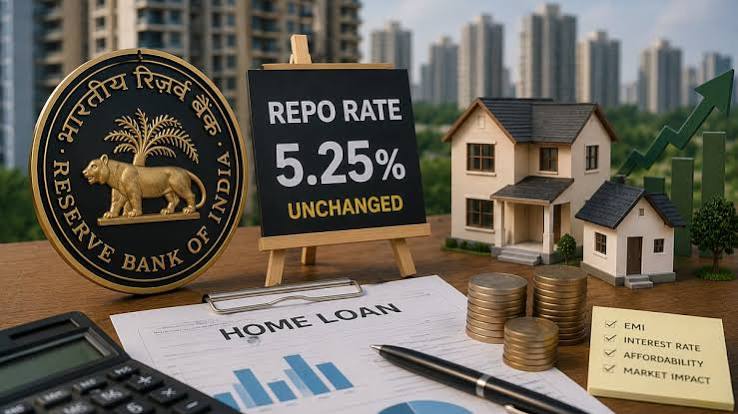
Home loan borrowers in India have received some relief after the Reserve Bank of India (RBI) kept the repo rate unchanged at 5.25% at its August 2026 monetary policy meeting. The decision provides greater stability for borrowers with floating-rate home loans, as banks are less likely to make immediate changes to lending rates following the policy announcement.
The RBI’s Monetary Policy Committee decided to maintain the benchmark repo rate at 5.25%, keeping its cautious approach intact amid uncertainty surrounding inflation, crude-oil prices and global economic conditions. All six members of the rate-setting committee voted to keep the policy rate unchanged.
For home-loan borrowers, a stable repo rate means there is no immediate policy-driven pressure for floating-rate lending rates to rise. This is particularly important for households that are already managing large monthly EMIs and may be sensitive to even small changes in borrowing costs.

Floating-rate loans linked to external benchmarks can respond to changes in the benchmark rate. When the RBI raises the repo rate, banks can increase lending rates, potentially pushing up EMIs or extending the repayment period. When rates fall, borrowers can benefit from lower interest costs, although the exact transmission depends on the lender and the loan’s benchmark.
With the RBI choosing to hold the rate steady, borrowers can get some predictability in their financial planning. Homebuyers considering new loans can also make decisions without having to immediately factor in another policy-rate increase.
However, the RBI’s decision does not mean that home-loan rates across all banks will remain exactly the same. Banks determine their lending rates based on several factors, including their benchmark, funding costs, credit risk and competitive conditions. Therefore, individual borrowers may see different interest rates depending on their lender and loan agreement.
The RBI’s decision comes at a time when inflation remains an important concern. Consumer inflation is expected to have increased to around 4.5% in July, according to a Reuters poll, after rising to 4.38% in June. The central bank nevertheless expects average inflation for the financial year to remain around 5%.
Crude oil prices are another risk. Higher oil prices can increase inflationary pressure because India imports a large share of its crude requirements. Geopolitical uncertainty and developments around the Strait of Hormuz have also made energy prices more difficult to predict.
At the same time, India’s economic growth remains relatively strong. The RBI raised its growth forecast for the financial year to 6.7%, supported by domestic demand and credit expansion. This gives the central bank some room to remain patient rather than making an immediate change in interest rates.
For borrowers, the stability is particularly useful because home loans are long-term financial commitments. Even a small change in the interest rate can have a significant effect over a 15-, 20- or 25-year repayment period.
For example, borrowers with floating-rate loans should keep an eye on their lender’s interest-rate reset schedule. A repo-rate pause does not automatically guarantee that the EMI will never change. Banks may revise lending rates for other reasons, and the impact can also depend on the borrower’s existing loan terms.
The RBI also provides protections for borrowers when interest rates on eligible floating-rate loans are reset. Under its framework, lenders must provide borrowers with options such as increasing the EMI, extending the loan tenure, switching to a fixed-rate loan where applicable, or making partial or full prepayments, subject to the applicable terms.
For the real estate sector, stable borrowing costs are also positive. Home purchases are highly sensitive to financing costs, particularly for middle-income buyers. When borrowers have greater certainty about EMIs, they may feel more comfortable making long-term property decisions.
Developers and housing finance companies are also likely to welcome the pause because stable rates can support demand for housing credit. The decision could help maintain consumer confidence during the important festive and property-buying season.
However, borrowers should not assume that rates will remain unchanged indefinitely. The RBI has kept its options open because inflation, oil prices and global developments could change the economic outlook. Recent market expectations suggest that economists are now looking at a later possibility of rate increases if inflationary pressures become broader.
For now, though, the message for home-loan borrowers is relatively positive. The 5.25% repo rate provides stability rather than another increase in borrowing costs, giving households some breathing room while they plan their finances.
The next major signals will come from India’s inflation data, crude-oil prices, global interest rates and domestic economic activity. If inflation remains manageable, borrowers could continue to enjoy a period of relatively stable interest rates. But if inflation rises significantly, the RBI may eventually have to reconsider its policy stance.
For homebuyers, the current environment therefore offers a period of stability, but it is still important to compare loan rates, understand the reset mechanism and avoid taking on a loan that stretches monthly finances too far.