

Germany’s trade relationship with China is undergoing a major shift, with the country’s trade deficit with Beijing widening sharply in the first half of 2026. The latest figures show that Germany is importing significantly more from China while selling fewer goods to the Chinese market, highlighting the growing competitive pressure facing Europe’s largest economy.
Germany’s trade deficit with China reached around €55 billion in the first six months of 2026, compared with roughly €40 billion during the same period a year earlier. German exports to China fell by more than 12% year-on-year to just under €37 billion, while imports from China increased by 8.9% to about €91.8 billion.
The figures are significant because China has traditionally been one of the most important markets for German manufacturers. For decades, German companies built their strength in China by selling cars, industrial machinery, chemicals, electrical equipment and other high-value products. China, meanwhile, supplied Germany with consumer goods, components and increasingly sophisticated industrial products.
That relationship is now changing.
Chinese companies have improved their capabilities across a wide range of industries and are increasingly able to produce products that previously depended on European technology and machinery. This means China is becoming less dependent on German industrial products while Chinese manufacturers are becoming stronger competitors both inside China and in international markets.
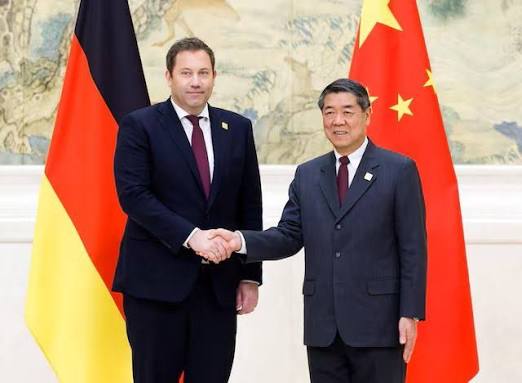
The decline in German exports is particularly noticeable in areas that have traditionally been central to the country’s industrial model. Automobiles, industrial equipment and chemicals have faced increasing competition as Chinese companies develop their own technology and manufacturing capacity. German carmakers, for example, have faced growing competition from Chinese electric-vehicle manufacturers in the world’s largest automobile market.
At the same time, German businesses continue to rely heavily on Chinese products and components. The increase in imports shows that Chinese manufacturers remain highly competitive on price, scale and supply-chain efficiency. This combination — weaker German exports and stronger Chinese imports — is creating a difficult environment for German manufacturers.
China nevertheless remains an extremely important trading partner for Germany. The issue is not simply that trade between the two countries is declining. Instead, the balance and structure of that trade are changing rapidly. Germany is moving from a relationship in which it supplied China with large quantities of advanced industrial goods toward one in which Chinese companies increasingly compete directly with German businesses.
The development is part of a wider challenge facing Germany’s manufacturing sector. German companies are also dealing with weaker European demand, high production costs and stronger competition from manufacturers in other parts of the world. US trade policies and tariffs have added another layer of uncertainty for export-oriented companies.
Germany’s overall exports have still shown some resilience. During the first half of 2026, German exports increased by around 3.7% to approximately €817 billion. However, exports to the United States, Germany’s largest individual market, declined by about 6%.
The Chinese market is therefore becoming an increasingly complicated opportunity for German companies. It remains too large and important to ignore, but German manufacturers can no longer assume that their traditional technological advantage will guarantee strong sales.
The changing trade pattern is also creating pressure on employment and investment. Major German industrial companies, including automobile manufacturers, have already been restructuring operations and reducing costs as they respond to changing demand and increased competition.
For Germany, the challenge is to remain competitive while adapting to a global industrial landscape that looks very different from a decade ago. Companies may need to invest more heavily in software, artificial intelligence, electric vehicles, automation and other advanced technologies to maintain their position.
German policymakers are also trying to balance economic interests with concerns about excessive dependence on China. Berlin has continued to argue for engagement and dialogue, even as several European governments push for stronger measures to protect European industries from Chinese competition.
The issue is broader than Germany. The European Union itself is facing a growing trade imbalance with China. Eurostat data show that the EU’s goods trade deficit with China widened significantly, reaching €98 billion in the first quarter of 2026.
For investors, the changing Germany-China trade relationship could have important consequences for companies in automobiles, machinery, chemicals, engineering and other industrial sectors. Businesses with diversified markets and strong technological advantages may be better positioned to handle the pressure, while companies heavily dependent on Chinese demand could face greater challenges.
The latest trade figures therefore point to a structural change rather than a temporary movement. China is no longer simply a major customer for German industry. In many areas, it is becoming a direct competitor.
For Germany’s famous “Made in Germany” industrial model, that may be one of the biggest economic challenges of the coming years. The country’s ability to adapt to China’s rapid industrial progress, while finding new markets and technologies, will be crucial for maintaining its position as one of the world’s leading manufacturing economies.