
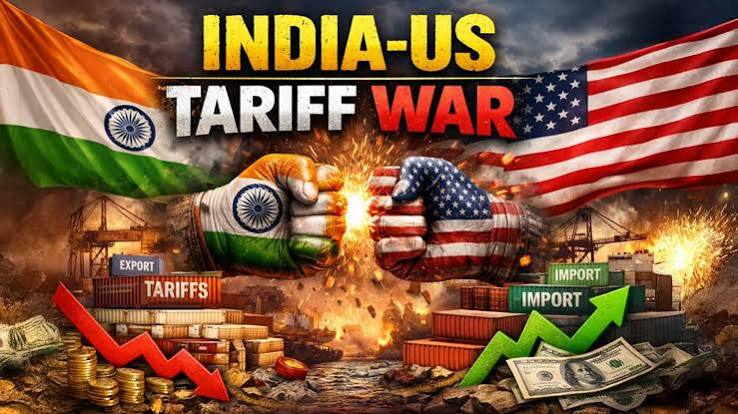
Trade relations between India and the United States are once again under pressure as Washington considers tougher tariff measures linked to India’s continued purchases of Russian oil. The latest developments have brought the trade dispute back into focus for exporters, businesses and investors, with concerns that higher duties could increase costs and make Indian products less competitive in the US market.
The situation has become particularly sensitive because the two countries had earlier moved toward a trade framework that was expected to reduce some of the tariff pressure. In February 2026, the United States announced a framework under which the reciprocal tariff on Indian goods was to be reduced from 25% to 18%, while India agreed to reduce or eliminate tariffs on a range of American industrial and agricultural products. The agreement also included plans for India to purchase more US energy, technology and other products.
However, relations have become more complicated because of India’s continued imports of Russian crude oil. Washington has been pushing countries to reduce purchases of Russian energy as part of its wider pressure on Moscow. The issue has now become a major point of disagreement between India and the United States.
US officials have recently indicated that the tariff question could become significantly more serious. White House Trade Adviser Peter Navarro said that US President Donald Trump and Prime Minister Narendra Modi have a strong relationship and would work through the disagreement surrounding Russian oil purchases.

The possibility of higher tariffs is being watched closely by Indian exporters. The United States is one of India’s most important overseas markets, and sectors such as textiles, leather, engineering goods, chemicals, pharmaceuticals, jewellery, marine products and auto components have significant exposure to American demand.
Indian policymakers are also aware of the potential impact on smaller exporters. A parliamentary panel recently urged the government to move quickly toward a bilateral trade agreement with Washington and recommended additional support for businesses affected by US tariff measures. The panel specifically highlighted labour-intensive industries and suggested measures such as export credit, insurance and technical assistance for smaller exporters.
For Indian companies, higher tariffs could make products more expensive for American buyers. Exporters may have to absorb part of the additional cost to remain competitive, which could reduce profit margins. Alternatively, companies could increase prices, but that could make their products less attractive compared with goods supplied by competitors from countries facing lower tariffs.
The impact would not necessarily be the same across all industries. Companies with strong pricing power or diversified export markets may be better positioned to manage the pressure. Businesses that depend heavily on the US for their sales could face greater challenges.
The dispute is also being closely followed by financial markets. Investors are likely to watch companies with significant US exposure, particularly exporters in sectors such as pharmaceuticals, textiles, chemicals, jewellery and engineering. Currency movements could also become important because a weaker rupee can partly offset the impact of higher tariffs for exporters, although it also raises the cost of imported inputs.
At the same time, India has been working to reduce its dependence on any single overseas market. The country has been pursuing trade agreements and expanding commercial relationships with other major economies. India and the European Union concluded a major free-trade agreement in January 2026, although the agreement still requires the necessary approval processes before it becomes fully effective. Such trade diversification could become increasingly important if uncertainty with the US continues.
For Washington, the issue is not simply about tariffs. The US-India relationship also covers defence, technology, energy, critical minerals and supply-chain cooperation. Both countries have strong strategic reasons to maintain their broader partnership, which could encourage negotiations even as disagreements over trade and Russian oil continue.
The immediate focus is therefore on whether the two governments can find a compromise before additional tariff measures are imposed. Recent comments from US officials suggest that dialogue remains possible, while Indian policymakers are continuing to push for greater stability and predictable market access for exporters.
For Indian businesses, the uncertainty itself is a challenge. Companies planning investments, export contracts and production capacity need greater clarity about the tariff environment. A stable trade arrangement with the US would give exporters more confidence and could support long-term investment.
The coming weeks could therefore be important for the future of India-US trade. If negotiations succeed, both countries could move toward a more predictable trading relationship. If tensions increase and tariffs rise further, Indian exporters may have to look for new markets, adjust pricing strategies and prepare for tougher competition.
For now, markets and businesses are watching Washington closely. The final outcome will depend on negotiations between the two governments, but the tariff issue has once again become one of the most important external risks facing India’s export sector.