
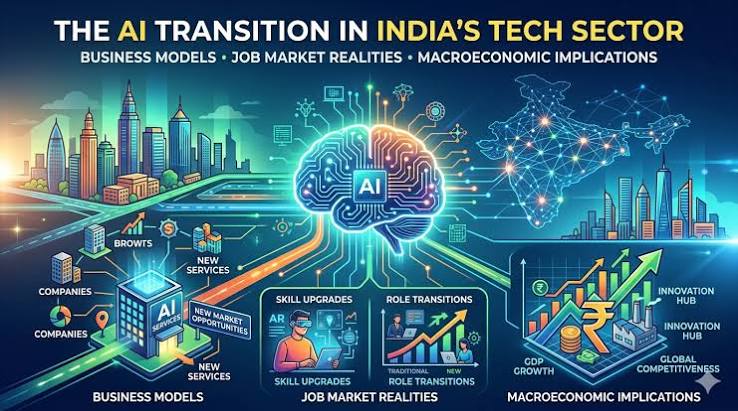
India’s information technology industry is entering a major period of change as artificial intelligence begins to alter how software is developed, services are delivered and companies build their business models. The shift is being felt across the industry, from large IT services firms to software developers and technology professionals.
For decades, India’s IT sector grew largely by providing large teams of engineers to global companies for software development, maintenance, testing and business-process work. That model helped create millions of jobs and made companies such as TCS, Infosys, Wipro and HCLTech global technology providers. AI is now challenging parts of that model by allowing companies to automate tasks that previously required large teams.
The impact is already visible in hiring. Recent industry reports indicate that Indian IT companies are becoming more selective about adding employees, even as demand for AI-related skills increases. Revenue is also growing faster than headcount in parts of the sector, suggesting that companies are trying to generate more business without increasing their workforce at the same pace.
Software development is one of the areas seeing the biggest change. AI coding assistants can help developers write, test and review code, reducing the time needed for some routine assignments. Similar tools are being used for documentation, customer support, data analysis and software testing.
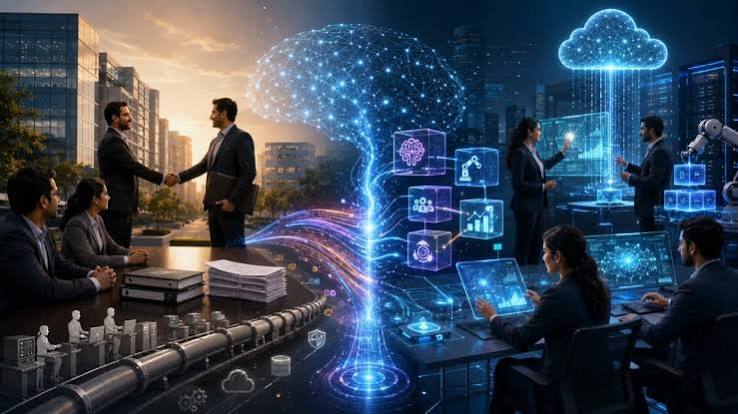
However, the transformation does not simply mean that AI will replace every technology worker. Instead, the nature of many jobs is expected to change. Developers may spend less time writing repetitive code and more time designing systems, checking AI-generated output, solving complex problems and working directly with clients.
This is creating strong demand for new skills. Knowledge of artificial intelligence, machine learning, cloud computing, data engineering and cybersecurity is becoming increasingly valuable. Companies are also looking for employees who understand how to apply AI to specific industries rather than simply knowing how to use an AI chatbot.
For Indian IT companies, the change is also about protecting their traditional business model. If customers can use AI to complete certain software and support tasks with smaller teams, they may reduce spending on conventional outsourcing services. IT firms therefore need to move toward higher-value services such as AI implementation, consulting, automation, cloud transformation and specialised technology solutions.
The shift could also change the economics of the industry. A business that previously required hundreds of employees may increasingly be handled by a smaller team using AI tools. This could improve productivity and margins for IT companies, but it may also reduce demand for some entry-level and routine positions.
That is one of the biggest concerns for India’s large pool of technology graduates. Recent reports have pointed to weaker hiring and job cuts across parts of the technology industry, while companies simultaneously invest heavily in AI capabilities.
At the same time, AI is creating new opportunities. Companies need people who can build AI systems, manage data, train models, integrate AI into existing software and ensure that automated systems operate safely and accurately. This means the industry could see a gradual shift from traditional software jobs toward more specialised technology roles.
Indian IT companies are already responding by investing in AI platforms, training programmes and new services. The broader industry is also discussing how companies can develop AI-focused business models while maintaining human oversight and responsible use of the technology.
For India, the stakes are particularly high because the IT industry is an important source of exports, employment and economic activity. The country has built a strong position in global technology services, but maintaining that advantage will depend on how quickly its companies and workforce adapt to AI.
The coming years are therefore likely to bring both opportunities and disruption. AI could allow Indian technology companies to deliver more sophisticated services at lower costs, while workers with outdated skills may find it harder to compete.
The message for the industry is becoming clear: AI is not just another technology upgrade. It is changing how software work is organised, how companies earn revenue and what skills employers value. India’s ability to reskill its workforce and move toward higher-value AI services will play a major role in determining the next chapter of its IT industry.